RSS
Posts
Comments

Karate videos (A-Z)

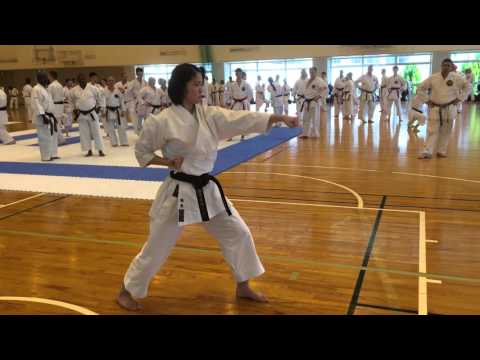
Chatanyara no Kushanku

Chatanyara no Kushanku originates from Okinawa, but now from the area of Shuri. The name of this kata comes from the Chinese military man Kung Hsiang Chung, who has taught Sagukawa his art of fighting. Many of these “Chinese Masters” traveled through Japan to propagate their arts. Via Okinawa this kata arrived at the continent. There [...]

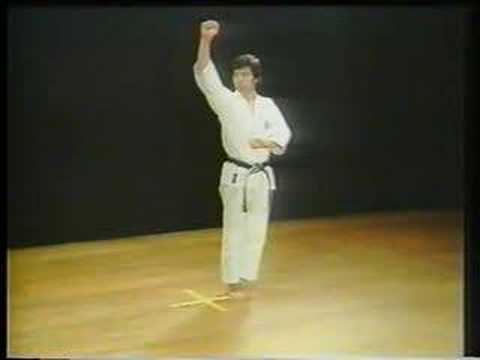
Chinte

Chinte (Japanese: “Rare Hand” or “Unusual Hand”) is a very old kata originating from China. Its mixture of standard movements and rarely seen techniques, vestiges of ancient forms, give this kata a special appeal. Particularly dynamic, with its alternating strong and slow passages, Chinte is unique also in the presence of a number of circular [...]

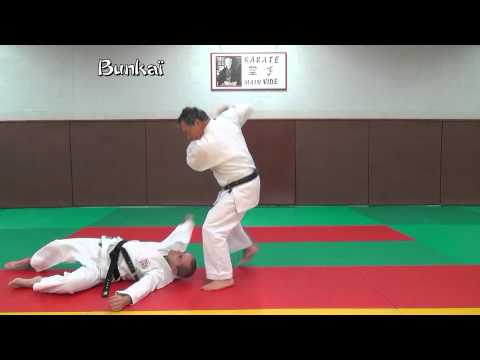
Chinte bunkai

Chinte (Japanese: “Rare Hand” or “Unusual Hand”) is a very old kata originating from China. Its mixture of standard movements and rarely seen techniques, vestiges of ancient forms, give this kata a special appeal. Particularly dynamic, with its alternating strong and slow passages, Chinte is unique also in the presence of a number of circular [...]

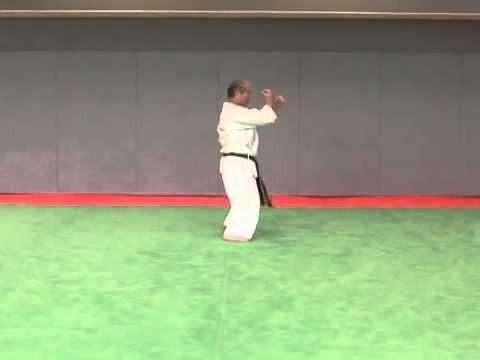
Chinto Shito Ryu

Chintō (in Shotokan, “Gankaku“) is an advanced kata practiced in many styles of Karate. According to legend, it is named after a Chinese sailor, sometimes referred to as Annan, whose ship crashed on the Okinawan coast. To survive, Chintō stole from the crops of the local people. Matsumura Sōkon, a Karate master and chief bodyguard [...]

Chinto Wado Ryu

Chintō (in Shotokan, “Gankaku“) is an advanced kata practiced in many styles of Karate. According to legend, it is named after a Chinese sailor, sometimes referred to as Annan, whose ship crashed on the Okinawan coast. To survive, Chintō stole from the crops of the local people. Matsumura Sōkon, a Karate master and chief bodyguard [...]

Goju Ryu Miyagi Chogun

Grandmaster Chojun Miyagi was born on April 25, 1888. He began training in karate under Kanryo Higaonna at the age of 14, in 1902. Like his teacher before him, because of his great natural talent and fierce determination, he progressed very rapidly. The training was severe beyond belief at times but he practiced ever harder [...]

Chuck Norris karate

Carlos Ray “Chuck” Norris (born March 10, 1940) is an American martial artist and actor. After serving in the United States Air Force, he began his rise to fame as a martial artist and has since founded his own school, Chun Kuk Do. As a result of his “tough guy” image, an Internet phenomenon began [...]

Cynthia Rothrock

Cynthia Rothrock (born March 8, 1957) is an American martial artist and actress specializing in martial arts films. Rothrock is five-time World Karate Champion in forms and weapons between 1981 and 1985. These categories are not combat-oriented, being displays of fluidity of movement rather than fighting, and are therefore not segregated into male and female [...]

Daido Juku

Daido Juku is the organization for the martial art Kudo, founded in 1981 by Takashi Azuma. Azuma, originally a Kyokushin karate 1977 full contact karate champion, resigned from the Kyokushin organization to form Daido Juku in Sendai city, located in northern Honshū, Japan. Daido Juku literally translated means “School of the Great Way”. It incorporates [...]

Empi

Empi is a kata practiced by Shotokan and other karate styles. Empi means Flying Swallow. Empi comes from the Okinawan martial art of Tomari-te, where it first appeared in 1683. It is believed to have been influenced by Chinese boxing. It was originally called Wansu. Funakoshi Gichin changed the name to Empi when he moved [...]

Empi bunkai

Empi is a kata practiced by Shotokan and other karate styles. Empi means Flying Swallow. Empi comes from the Okinawan martial art of Tomari-te, where it first appeared in 1683. It is believed to have been influenced by Chinese boxing. It was originally called Wansu. Funakoshi Gichin changed the name to Empi when he moved [...]

Enter The Dragon  1973 trailer

Enter the Dragon is a 1973 Hong Kong martial arts co-production with Golden Harvest and Warner Bros. studios, directed by Robert Clouse; starring Bruce Lee and John Saxon. This is Bruce Lee’s final film appearance before his death on July 20, 1973. Six days after Lee’s death, the film was released on July 26, 1973 [...]

Fight Quest  Karate full

In this episode of Fight Quest Doug and Jimmie study Kyokushin Karate. They train for a five man kumite (five one minute full contact rounds) after five days of training under the guidance of two top Kyokushin Karate instructors.

Fumikomi geri

Fumikomi geri is a Karate technique. It’s a stompimg kick in a downward direction. It is used in Katas like Bassai Dai and self defense. Targets of the Fumikomi geri are generally the knee, the hip and the groin.

Gankaku

Shotokan’s Gankaku is an advanced kata practiced mainly by black belts. The original name for Gankaku is Chinto. Stories are told of a Chinese sailor named Chinto, who was shipwrecked off the coast of Okinawa. To survive, Chinto stole from the crops of the local Okinawan people. Sokon Matsumura, a Karate master, was sent to [...]

Gankaku bunkai

Shotokan’s Gankaku is an advanced kata practiced mainly by black belts. The original name for Gankaku is Chinto. Stories are told of a Chinese sailor named Chinto, who was shipwrecked off the coast of Okinawa. To survive, Chinto stole from the crops of the local Okinawan people. Sokon Matsumura, a Karate master, was sent to [...]

Garyu Kyokushinkai

The kata Garyu, is not taken from traditional Okinawan karate but was created by Oyama and named after his pen name (Garyu = reclining dragon), which is the Japanese pronunciation of the characters 臥龍, the name of the village (Il Loong) in Korea where he was born. In Japanese philosophy, a great man who remains in [...]

Gedan barai

Gedan barai is a karate technique mainly used for blocking an attack. The approximate English meaning is ‘low level sweep’. Standing in natural stance, and in a yoi (ready) position, bend left forearm up until fist reaches near the right ear while the right arm moves slightly in to the middle. The left elbow should [...]

« Prev - Next »